
If you’ve ever found yourself staring at a Virginia SOL document trying to turn standards into student-friendly language, you’re not alone.
Between lesson planning, grading, parent communication, meetings, and everything else on your plate, rewriting standards isn’t usually at the top of anyone’s wish list. Yet many schools expect teachers to post learning targets, display standards, or maintain a standards wall throughout the year.
That’s why I created these Virginia SOL I Can Statements.
Instead of spending your planning time rewriting standards, you can print, display, and teach. The statements are already aligned to the Virginia Standards of Learning and come in an editable format so you can make changes if needed.
Whether you love I Can Statements, tolerate them, or just need them posted before your next walkthrough, having them ready to go can save a lot of time.
Kindergarten teachers have enough to juggle without rewriting every standard into student-friendly language. These editable I Can Statements help make learning goals visible for your youngest learners while saving you time.
Use them for:
First grade students are becoming more independent learners, and clear learning targets can help them understand what they’re working toward.
These editable objectives make it easy to display standards in language students can understand while keeping your classroom organized and aligned to the Virginia SOLs.
Second grade covers a wide range of skills across subjects, and keeping standards organized can quickly become overwhelming.
These I Can Statements provide a simple way to communicate learning goals and maintain a consistent standards display throughout the school year.
Third grade is often when testing and standards become a bigger focus. Having learning targets already prepared can help streamline your planning and make it easier to communicate expectations to students.
The editable format also allows you to customize wording to fit your classroom needs.
By fourth grade, students are tackling increasingly complex skills. Clear learning targets can help break down those expectations into manageable goals.
These Virginia SOL I Can Statements make it easy to keep standards visible without spending hours creating your own materials.
Fifth grade teachers are balancing a packed curriculum and preparing students for middle school expectations. Having ready-to-use learning targets means one less thing to create from scratch.
Display them during lessons, organize them by strand, or use them as part of your classroom’s standards wall.
One of the biggest frustrations with pre-made resources is finding something that’s almost perfect.
That’s why all of these Virginia SOL I Can Statements are editable.
Need to adjust wording? Add specific language your school uses? Change fonts or formatting to match your classroom decor? You can do that.
The goal isn’t to give you one more thing to manage. The goal is to save you time.
Teaching already comes with enough responsibilities. If posting learning targets or displaying standards is part of your school’s expectations, there’s no reason to spend hours rewriting standards yourself.
These Virginia SOL I Can Statements give you a ready-to-use starting point for Kindergarten through 5th Grade, helping you spend less time formatting objectives and more time focusing on your students.
Browse the grade level that fits your classroom and check one more task off your list.
Need SOL-aligned resources?
What it covers:
What dissolves in water and how temperature changes that.
How I explain it to kids:
You know how sugar disappears in tea? That’s dissolving. Cold tea? Not so much.
Helpful Classroom Idea:
Have students conduct a dissolving test with warm and cold water. Use sugar, salt, oil, and sand. Provide a table where they record what dissolves, what doesn’t, and how temperature makes a difference. This can lead into a discussion about mixtures and solutions.
Need SOL-aligned resources?
What it covers:
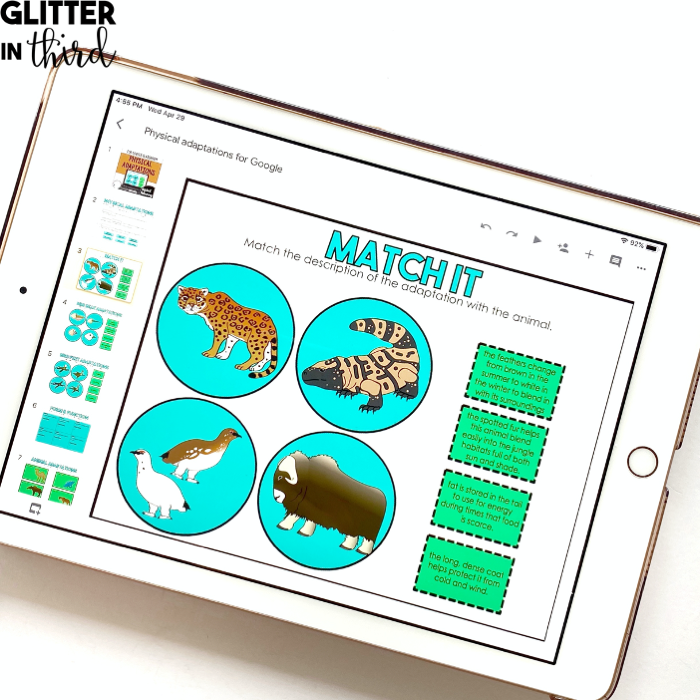
How animals survive and how fossils show what lived long ago.
How I explain it to kids:
Animals have cool traits that help them live in their homes. And fossils are nature’s way of leaving behind clues.
Helpful Classroom Idea:
Use pictures or short videos to introduce physical vs. behavioral adaptations (e.g., hibernation vs. sharp claws). Then, have students create an “adapted animal” for a specific environment (arctic, rainforest, desert) and explain their survival traits. For fossils, press small objects into clay and “excavate” each other’s fossils the next day.
Need SOL-aligned resources?
What it covers:
Living vs. nonliving things, food chains, energy, roles like producers and decomposers.
How I explain it to kids:
Everything works together like a team—plants, animals, the sun, the dirt, even the bugs.
Helpful Classroom Idea:
Create food chain cards and have students build their own food chains or webs using string or arrows to connect the parts. Add decomposers like fungi and worms to make it more realistic. Use examples from familiar environments like forests, ponds, or even a backyard.
Need SOL-aligned resources?
What it covers:
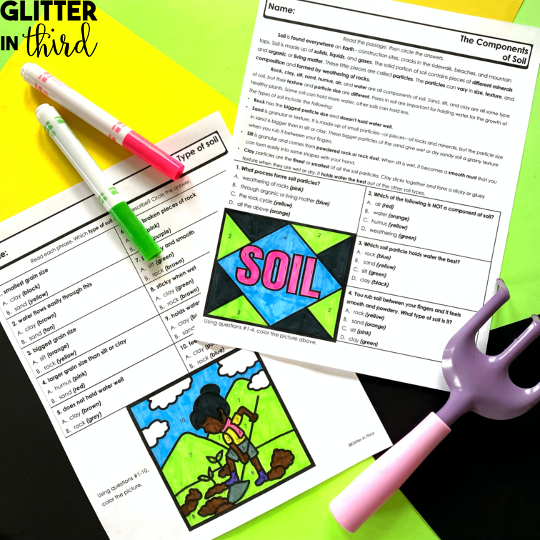
Types of soil and how they help plants.
How I explain it to kids:
Soil helps plants grow. Some soil holds water better, and some has more food in it.
Helpful Classroom Idea:
Let students test 3 types of soil (sand, clay, and potting soil) by planting bean seeds in each. Have them water the plants equally and observe which ones sprout first or grow taller. Tie in observations with soil composition and water retention.
Need SOL-aligned resources?
What it covers:
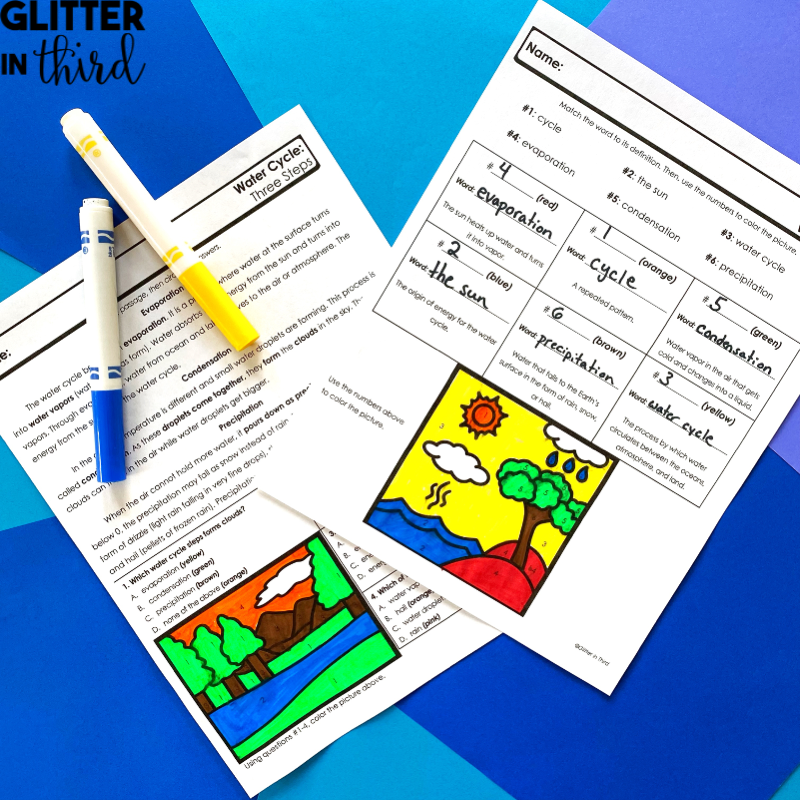
Evaporation, condensation, precipitation, and water sources on Earth.
How I explain it to kids:
Water is always moving. It goes up, makes clouds, and falls back down again.
Helpful Classroom Idea:
Use a clear plastic cup of warm water, cover it with plastic wrap, and place an ice cube on top. Watch condensation form under the plastic. Use this as a live model to introduce the cycle. Label a water cycle diagram together afterward.
Need SOL-aligned resources?
What it covers:
Pollution, natural disasters, and taking care of Earth.
How I explain it to kids:
We need to protect our Earth. That means recycling, saving water, and not tossing trash everywhere.
Helpful Classroom Idea:
Create a simple conservation checklist. Have students record ways they helped the Earth during the week (turning off lights, recycling, picking up trash). For natural events, show pictures of floods, fires, or storms and discuss how people prepare and respond.
Need SOL-aligned resources?
This one’s woven through the entire year. It’s not a separate unit—it’s how we do science all year long.
Students are expected to:
It’s about building science habits that go way beyond a test.
Helpful Classroom Idea:
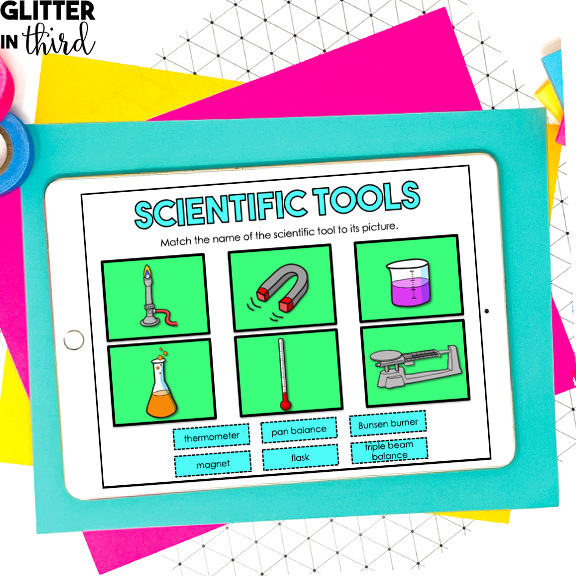
Start a “Wonder Wall” where students can post science questions. Choose one each week to investigate as a class. Use magnifying glasses, rulers, or thermometers as often as possible so students get comfortable using real tools. Even simple activities—like measuring how fast ice melts in different spots around the room—can help build observation and inquiry skills. Keep it low-pressure. The goal is to help students see themselves as scientists, not just science learners.
Need SOL-aligned resources?
You meant to plan science over the summer… and then summer did what summer does. (Same here. I blinked and suddenly it was August and I was out of glue sticks and brain cells.)
If you’re looking for a done-for-you way to tackle the entire 3rd grade science year without piecing together random resources or reinventing the wheel, I’ve got three bundles that might just be your new best friends:
The 3rd Grade Science Interactive Notebook Bundle
Hands-on, engaging, and super kid-friendly. You’ll get flipbooks, vocabulary, diagrams, and meaningful activities for every standard. It’s everything you need to build interactive notebooks that actually work—no fancy supplies or Pinterest stress required.
The 3rd Grade Science Google Classroom Bundle
All the same standards—just digital. Ideal if you’re teaching in Google Classroom, need sub plans that won’t require paper, or just want to stop wrestling with the copy machine.
The 3rd Grade Science Jeopardy Games Bundle
Need a way to review that doesn’t feel like review? These games are the easiest way to sneak in engagement and check for understanding. Your students will beg to play—and you’ll quietly pat yourself on the back.
Grab one, or go all in and get all three. Either way, your future self will thank you. (Possibly with coffee.)
Everything’s aligned to the 2018 Virginia SOLs and designed to feel doable on a Wednesday afternoon with 25 kids and zero energy.
Because let’s be honest—you’ve got enough on your plate already.
You don’t need to be a science genius. You just need to be willing to try something hands-on, talk through the vocabulary, and give your students space to think like scientists.
It doesn’t have to be perfect. Your kids will remember the messy experiments, the dirt under their fingernails, and the moment their seed finally sprouted way more than they’ll remember a worksheet.
And if science feels like a lot right now, just wait until you peek at the new social studies SOLs. (Yep, they changed those.) I broke it all down right here so you can see what’s different and how to make it work in your classroom.
You’ve got this.